
Below is a Market Reflection from our strategic partners at Gradient Investments
By Lisa Schreiber
Over the past several years, small-cap stocks have largely played a supporting role in US equity markets, overshadowed by the dominance of large-cap stocks and a small group of familiar leaders. But market leadership is not permanent. The outperformance of international markets relative to the US in 2025 is a reminder that leadership can and does shift. As concentration peaks and expectations reset, the market may be setting up for its own David-versus-Goliath moment.
Investors are beginning to look beyond what has already worked, and small-cap stocks are quietly re-entering the conversation. That shift makes it worth revisiting the key differences between large and small-cap companies and why the smaller ones may finally be poised for a comeback.
Small-cap stocks typically have a market capitalization of roughly $300 million to $2 billion. Many of these are earlier in their growth cycle and more domestically focused than their large-cap counterparts. While this can make them more sensitive to economic shifts and market volatility, it also gives them greater earnings leverage and long-term growth potential when economic conditions improve and leadership expands beyond a narrow set of companies.[1]
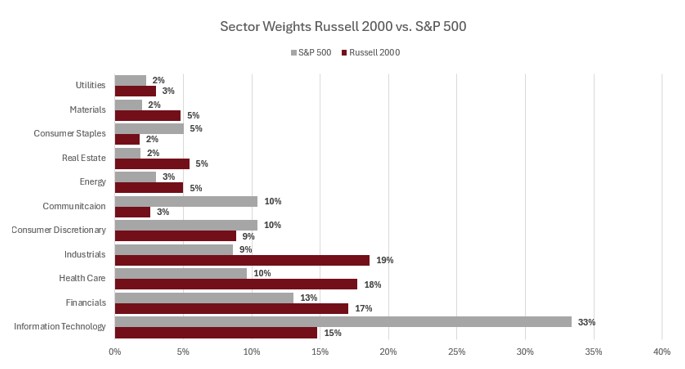
Sector composition also helps explain the performance gap between large- and small-cap stocks in recent years. The S&P 500’s outperformance relative to the smaller cap dominated Russell 2000 has been driven in large part by exceptional returns from the technology sector amid the ongoing AI investment cycle.
As seen in the chart below, information technology now represents approximately 33% of the S&P 500, compared with just 15% of the small- and mid-cap heavy Russell 2000. These structural differences mean the two indexes respond to different drivers, helping to explain why large caps have led while small caps lagged.[2]
Small-cap companies also tend to behave differently across the business cycle due to their size, funding structure, and revenue exposure. They are typically more reliant on the domestic economy and less diversified globally. Additionally, small caps are generally more sensitive to interest rates, as they often have higher borrowing needs and less access to lower cost capital than large, established companies.[3]
The early signs of 2026 suggest a shift may be underway. In the first two weeks of the year, the Russell 2000 gained 6.6%, compared to -0.7% for the S&P 500. [2] Several factors could support a more sustained re-emergence of small cap stocks. A rotation away from mega-cap concentration often coincides with growing confidence in the economic outlook.
Additionally, if inflation continues to moderate and the Federal Reserve signals a more stable interest-rate environment, small cap companies, many of which have greater exposure to floating-rate debt, could benefit as borrowing costs ease and capital becomes more accessible.
Earnings expectations may also provide a meaningful tailwind. Wall Street analysts currently project Russell 2000 earnings growth of approximately 35% annually over the next two years, compared to about 14% for the S&P 500. If realized, this divergence in growth expectations could further support a shift in market leadership toward smaller companies.[4]
At Gradient Investments, there are multiple ways to gain exposure to small- and mid-cap stocks. The G33 portfolio includes select exposure to small- and mid-cap growth companies, while the Endowment Series provides diversified access across the size spectrum. For investors seeking a more targeted positioning, our newest addition to the Gradient Investments portfolio family, the SMID Cap Select portfolio offers dedicated exposure to US small- and mid-cap stocks.
2 FactSet as of 1/20/2026
3 https://www.schwab.com/learn/story/whats-holding-back-small-caps?
4 https://www.barrons.com/articles/small-cap-stocks-s-p500-17241392
This endorsement of Gradient Investments, LLC, (GI) and its portfolio management services is provided by the firm. The firm refers clients to GI for portfolio management services. GI does not pay separate compensation to the firm in relation to its endorsement or any promotional services. However, the firm receives a portion of the advisory fees paid by clients who utilize the portfolio management services of GI. The firm also shares in the revenue of GI via quarterly payments based on the amount of total assets the firm places with GI. This endorsement incentivizes the firm in increasing the assets placed with GI, and therefore the compensation received by the firm. The firm and its investment advisor representatives are not supervised by GI. While these conflicts of interest exist, the firm and its investment advisor representatives are subject to fiduciary duty and must act in the best interests of their clients. The firm and their clients are not required to use GI and may select other investment managers.